NAD supplement side effects: what to expect from each type (and who should avoid them)

Most articles on NAD supplement side effects lump every product together. That is misleading, because a “NAD supplement” can contain niacin, niacinamide, nicotinamide riboside (NR), NMN, NAD+ itself or a mix with herbal extracts. Each has its own side-effect profile. Here is what to expect from each one.
Side effects by type of NAD supplement
| Type | Common side effects | Risks at high doses |
|---|---|---|
| Niacin (nicotinic acid) | Flushing, itching, stomach upset | Liver damage (especially extended-release), higher blood sugar, gout flares |
| Niacinamide (nicotinamide) | Nausea, stomach upset (uncommon) | Liver effects in the gram range |
| Nicotinamide riboside (NR) | Nausea, bloating, fatigue, headache (mild) | Little long-term data |
| NMN | Mild digestive complaints, headache | Little long-term data |
| Oral NAD+ / liposomal NAD+ | Digestive complaints | Very little data at all |
| IV NAD+ | Chest tightness, nausea, cramps, flushing during infusion | Depends on clinic and rate |
Niacin: the flush
Niacin (nicotinic acid) is the only common NAD+ precursor that causes the “niacin flush”: warm, red, itchy or tingling skin on the face and chest, usually starting 15 to 30 minutes after a dose of about 30 to 50 mg or more. It is uncomfortable but generally harmless.
The bigger concerns come with high doses used for cholesterol, typically 1,000 mg a day or more: liver damage (most often with extended-release forms), higher blood sugar, raised uric acid and gout, and stomach ulcers. Those doses should only be taken under medical supervision. Read more in our niacinamide vs niacin guide.
Niacinamide: well tolerated, with a ceiling
Niacinamide does not flush, which is why most NAD+ formulas use it. In studies, doses such as 500 mg twice a day were generally well tolerated. Problems appear mainly in the gram range: nausea, and in rare cases liver damage at around 3 grams a day or more.
One technicality: the US upper limit for supplemental niacin, 35 mg a day, applies to niacinamide too, even though it was set to prevent flushing from nicotinic acid. Many NAD+ products are well above it, so tell your doctor if you take one long term.
NR and NMN: mild and short-term
In human trials, NR at doses up to 1,000 mg a day and NMN at similar doses have been well tolerated. Reported side effects were mild and often no more common than with placebo: nausea, bloating, diarrhea, headache, fatigue, leg cramps and occasional skin rash.
The limitation is time. Most trials lasted weeks to a few months, so long-term safety data is still limited.
IV NAD+ and injections
IV NAD+ is the type most likely to cause noticeable side effects, and they are tied to infusion speed: chest pressure or tightness, nausea, abdominal cramping, flushing, headache and anxiety. Slowing the drip usually eases them. Injections can also cause pain, bruising and redness at the injection site.
There is very little published data on IV NAD+. In one small pilot study, NAD+ infused slowly over 6 hours disappeared from the blood for the first two hours without raising plasma NAD+, so how much benefit reaches your cells is uncertain. Clinic-administered NAD+ is not an FDA-approved treatment for any condition.
Interactions and who should avoid NAD supplements
Check with your doctor or pharmacist first if you:
- Have liver disease. High-dose B3 can worsen it.
- Take statins or blood pressure medication. High-dose niacin can add to their effects.
- Have diabetes. Niacin can raise blood sugar.
- Take antidepressants, triptans or tramadol and the formula contains L-tryptophan, because of the risk of too much serotonin.
- Have gout or stomach ulcers. Niacin can worsen both.
- Are pregnant or breastfeeding. There is not enough safety data, and L-tryptophan is advised against in pregnancy.
- Have or had cancer. NAD+ supports cell metabolism in general, including in cancer cells. This is a theoretical concern, but worth discussing with your oncologist.
How to keep side effects to a minimum
- Start low. Begin with half a dose for the first week.
- Take it with food, which reduces stomach upset.
- Take it in the morning if you notice restlessness or sleep problems.
- Choose niacinamide or NR over niacin if flushing bothers you.
- Read the full label. Multi-ingredient formulas add extras like L-tryptophan, green tea extract or resveratrol, each with its own profile.
The bottom line
For most healthy adults, oral NAD+ precursors at normal doses cause few and mild side effects. The real risks sit with high-dose niacin, very high doses of niacinamide, IV NAD+, and extra ingredients that interact with medication. Our EnduNAD review lists every ingredient with its dose and who should skip it.
Frequently asked questions
What are the most common NAD supplement side effects?
For oral precursors such as NR, NMN and niacinamide, the most commonly reported side effects are mild: nausea, stomach discomfort, bloating, diarrhea, headache and fatigue. Supplements with niacin (nicotinic acid) also cause flushing. IV NAD+ commonly causes chest tightness, nausea and cramping during the infusion.
Can NAD supplements damage your liver?
At normal supplement doses, liver problems are rare. The risk rises with high doses of B3: extended-release niacin from about 1,000 mg a day, and niacinamide in the gram range. If you have liver disease, talk to your doctor before taking any NAD+ supplement.
Can NAD supplements cause anxiety or insomnia?
Some people report restlessness or trouble sleeping, especially when taking NAD+ precursors late in the day. Evidence is mostly anecdotal. Taking the supplement in the morning is a simple way to avoid it.
Do NAD supplements interact with medications?
Possibly. High-dose niacin interacts with statins, blood pressure medication and diabetes drugs. Formulas containing L-tryptophan can interact with antidepressants. Check every ingredient on the label with your pharmacist if you take prescription medication.
Are NAD supplements safe long term?
Trials with NR and NMN have mostly lasted weeks to a few months, with good tolerability. Long-term safety data beyond that is limited, which is why it makes sense to use moderate doses and check in with your doctor if you take them for many months.
Sources
- Cleveland Clinic: NAD+ supplements, benefits and risks
- NIH Office of Dietary Supplements: Niacin fact sheet for health professionals
- Hwang and Song (2020). Possible adverse effects of high-dose nicotinamide: mechanisms and safety assessment. Biomolecules.
- Martens et al. (2018). Chronic nicotinamide riboside supplementation is well-tolerated and elevates NAD+ in healthy middle-aged and older adults. Nature Communications.
- Grant et al. (2019). Changes in the human plasma and urine NAD+ metabolome during a 6 hour intravenous infusion of NAD+. Frontiers in Aging Neuroscience.
- MedlinePlus: L-tryptophan
Read next

Best NAD supplement in 2026: honest picks by goal (and the label problem most lists ignore)
The best NAD supplement depends on your goal and budget. Honest picks for NR, combination and niacinamide formulas, plus why most NAD+ labels fail lab tests.

EGCG benefits: what green tea's key compound can and can't do
EGCG benefits explained: what green tea's main catechin does for metabolism, heart and cells, what the evidence shows, and the 800 mg liver safety threshold.

L-tryptophan benefits: sleep, mood and NAD+, plus the safety history you should know
L-tryptophan benefits for sleep, mood and NAD+ production, what the evidence shows, food sources, doses, the 1989 EMS outbreak and drug interactions.
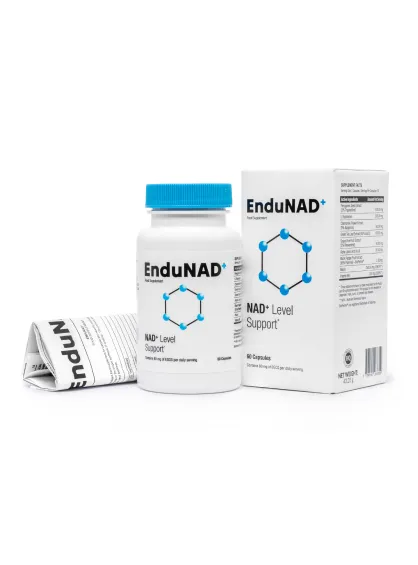
EnduNAD review
Ingredients, doses, what to realistically expect and who should skip it.
This page is general information, not medical advice. If you take medication, are pregnant or have ongoing symptoms, talk to your doctor first. These statements have not been evaluated by the Food and Drug Administration. This product is not intended to diagnose, treat, cure, or prevent any disease.